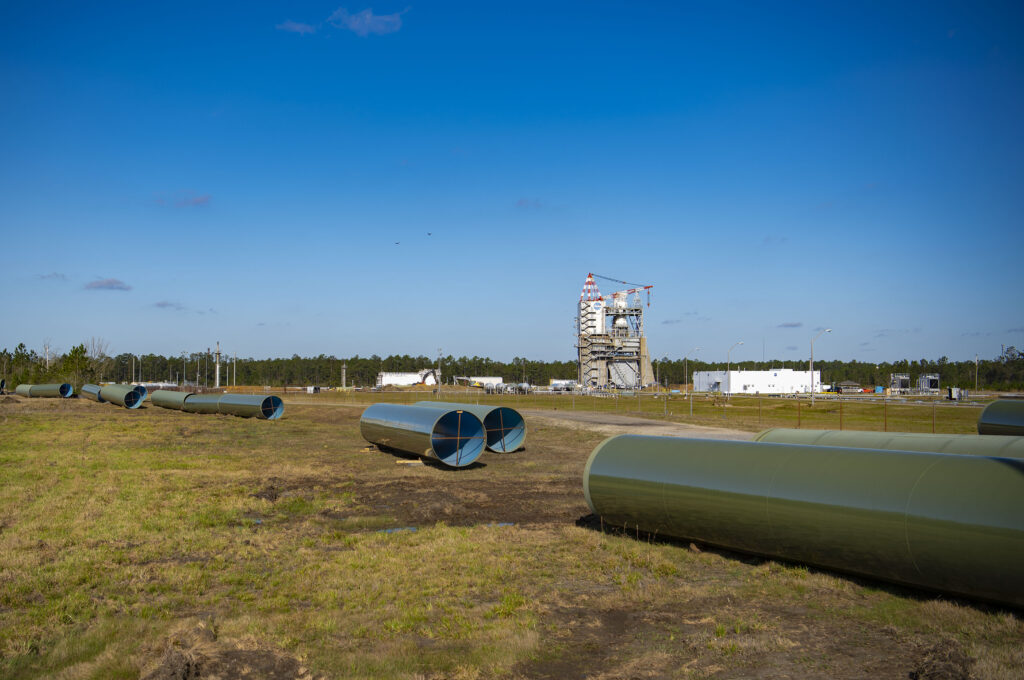
Replacing piping needed to flow 170,000 gallons of water a minute demands a clever bit of engineering ingenuity.
Just such a project is underway at NASA’s Stennis Space Center near Bay St. Louis as crews work to upgrade aging infrastructure by replacing 66-inch piping leading to the historic Fred Haise Test Stand.
Casey Wheeler, the NASA engineer spearheading the project, said this is the first time the water pipeline leading to the structure has been upgraded since its original installation.
A typical single-engine test at Stennis Space Center requires a lot of water – to cool super-hot engine exhaust, reduce test-related noise and vibrations, and use in the event of a facility or propellant barge fire. As much as 1.4 million gallons of water flows to the test stand during a typical eight-and-a-half-minute hot fire. At pressures reaching 225 pounds per square inch, the output is enough to fill about 2,125 standard bathtubs a minute.
The water flows from a 66-million-gallon reservoir at the Stennis High Pressure Industrial Water Facility.
Built in the 1960s, maintaining the facility and its related piping is an ongoing challenge. Part of the current project involves installing about 2,080 linear feet of new 75-inch piping from the HPIW facility to the valve vault pit serving the test stand. The existing 66-inch piping between these two points will be abandoned in place. Nearly all of the pipe required for this portion of the project is on site, though four sections still are being fabricated off site. Over 500 feet of the new 75-inch pipe has been laid. A second portion of the project involves approximately 580 feet of existing 66-inch piping running from the valve vault pit to the test stand. This stretch of piping runs adjacent to a complicated network of underground utilities that could be damaged from intensive digging.