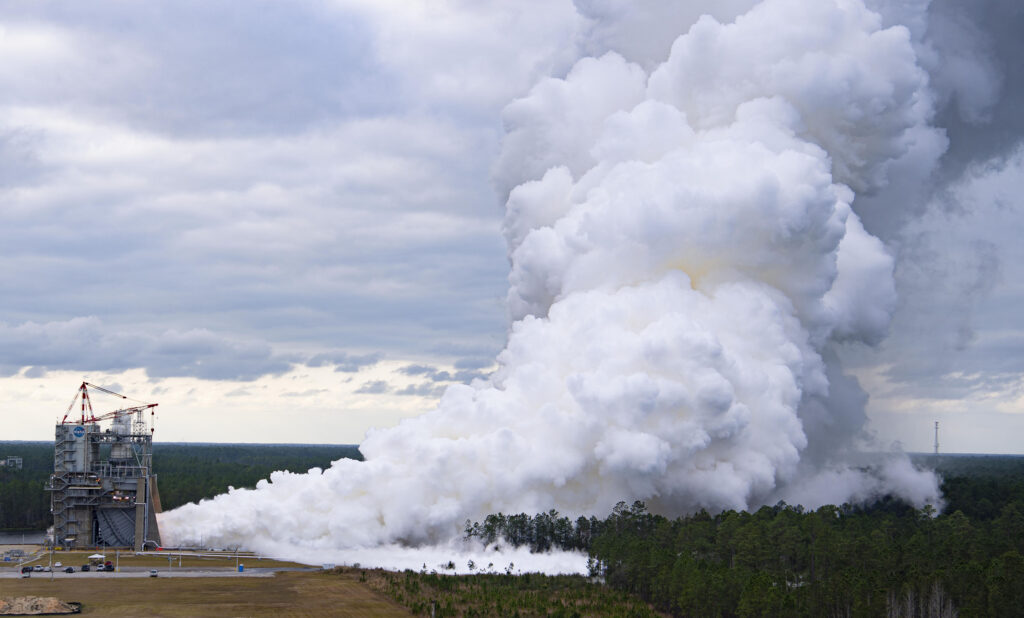
Over at Stennis NASA conducted a successful full-duration test Dec. 15 to begin a new series of testing for state-of-the-art RS-25 engines to help power the agency’s Space Launch System (SLS), America’s new deep-space rocket, on future missions to the Moon and Mars.
The first hot fire of the new series was conducted for a full-duration 500 seconds on the Fred Haise Test Stand (formerly A-1 Test Stand) at Stennis Space Center, near Bay St. Louis.
The upcoming test schedule is divided into three phases: An initial series of five tests scheduled into next spring will use development engine No. 0525 to gather performance data on a variety of new engine components manufactured with state-of-the-art fabrication techniques, like hot isostatic pressure bonding and selective laser melting, to reduce both the cost and time to build new engines. A second phase of 12 tests will begin next summer with a certification engine produced with all new parts in Aerojet Rocketdyne’s factory in DeSoto, California. It is identical to new engines being manufactured for flights after Artemis IV. A third phase of 12 tests will follow the certification series and will be conducted with the development engine, which will have many of the same parts as the certification engine and also will be used to certify the new engines for flight.
Four RS-25 engines, along with a pair of solid rocket boosters, will help power SLS at launch. Firing simultaneously, the engines will generate a combined 1.6 million pounds of thrust at liftoff and 2 million pounds during ascent.
NASA already has completed testing of engines for the first four Artemis missions as part of the agency’s plan to return humans, including the first woman and first person of color, to the Moon in preparation for eventual missions to Mars.