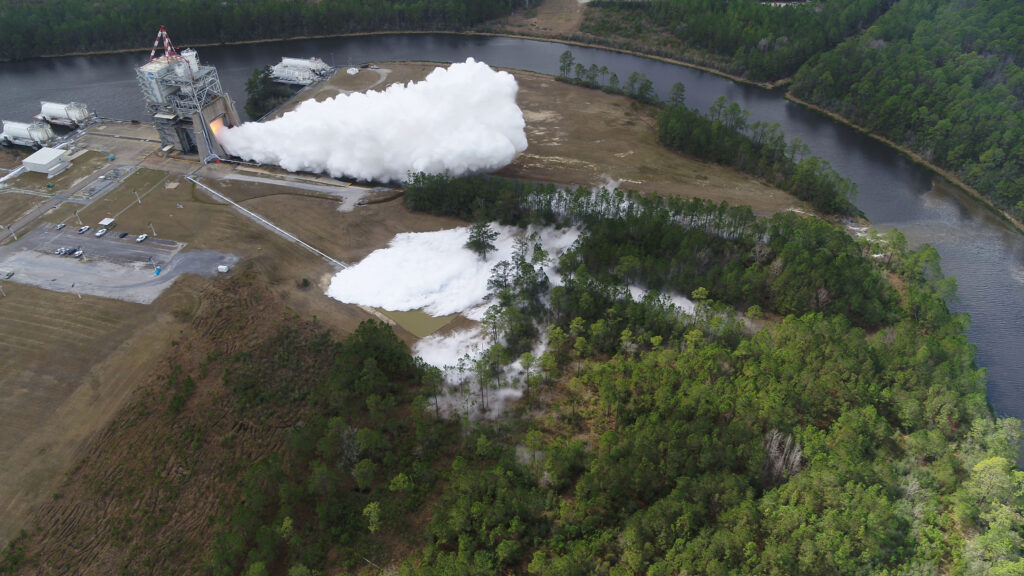
NASA powered up its third RS-25 engine hot fire test of the new year yesterday at Stennis Space Center near Bay St. Louis.
NASA is testing RS-25 engines to help power the agency’s Space Launch System (SLS) rocket on future deep space missions.
Initial SLS missions will send the agency’s Orion spacecraft to the Moon as part of NASA’s Artemis program.
Work is underway inside the Vehicle Assembly Building at NASA’s Kennedy Space Center in Florida to prepare the first SLS for the upcoming launch of the uncrewed Artemis I mission, which will pave the way for future flights with astronauts to explore the lunar surface and prepare for missions to Mars.
SLS will be the world’s most powerful rocket and the only one capable of sending the Orion, astronauts, and supplies to the Moon in a single mission.
The testing is part of NASA and Aerojet Rocketdyne’s effort to use advanced manufacturing methods, significantly reducing the cost and time needed to build new engines.
For NASA’s Feb. 24 test, engineers fired the RS-25 developmental engine for a full duration of about eight-and-a-half minutes (500 seconds), the same amount of time the engines must operate to help send SLS to space.
SLS, Orion, commercial human landing systems, and Gateway outpost in orbit around the Moon are NASA’s backbone for deep space exploration.